
Fixing America's Jails
The challenge of reducing jail populations and differential treatment simultaneously

Summer is spinning by, and it has actually been pretty glorious, at least by mid-Atlantic standards. Well, until last week’s inferno, but I was away somewhere cooler. The weather folks promise brief spells of torturous heat next week and beyond, but until then, I can sit comfortably on my covered porch and ruminate. Ruminating being a good thing for a writer to do. I listened to a Tyler Sheridan podcast recently, who cited long morning walks as the inspiration for his incredible productivity. This fits well with my amateur survey of the habits of great writers. They seem to have subscribed, almost uniformly, to bursts of creativity, usually in the morning, followed by lots of unstructured visiting and reading. In sum, a childlike approach to work. It's good to be a great writer, then. But I have bills to pay, so let’s get to it.
It is widely believed, I think, that our nation’s jails have (at least) two properties that require reform. There are too many people in jail, and there is differential treatment by race.
The central challenge is that it is easier (but still really hard) to reduce the number of people going to jail than it is to reduce the disparate treatment. What I’ll show you below is the algebra (and there is algebra!) of why doing these two things simultaneously is incredibly hard. Simply reducing the number of people who go to jail will not, by itself, reduce disparities.
I do not want to presume that everyone agrees with these goals. Let me just make a brief evidence-based case for why we should.
It is important to say here that jail and prison serve different purposes. Jails, in general, serve as holding facilities for people awaiting criminal processing. They also hold people sentenced to less than 12 months. Typically, many more people enter jail for case processing than are sentenced, although these pre-trial people tend to be there for short periods, a week or two, while the sentenced populations are there for a month or two, and thus on any given day, the proportion of people in jail is a little more balanced. But generally, people in jail are there prior to a conviction, and thus their detention is not specifically about punishment.
This is an important point because the popular press tends to conflate the goal of jail, which is about criminal case processing (not punishment), with the goal of prison, which is about punishment. And we know a lot of people go to jail each year, as there are typically between 7.5 and 8 million jail admissions each year. Far fewer go to prison, less than half a million.
Talking about jail in a specific year misses the larger point: there is cumulative exposure to jail. Going to jail is a profoundly impactful event in a person’s life, and we should be careful, as a society, that it is not overprescribed.
We don’t know exactly how many people go to jail in their lifetime. We do know from the Brennan Center that by age 23, about one-third of people have been arrested, and that the total number of people with an arrest record is roughly the same as the total number with a bachelor’s degree.
I think one informative way to look at this is to ask how likely a man is to go to jail compared with how likely he is to go to college. In addition to the Brennan Center facts above, we also know that 1) not everyone who is arrested spends time in jail, even for processing, but 2) men are arrested far more often than women, and 3) men are arrested for the first time after age 23, plus 4) men now go to college at rates below women.
Thus, the number of men going to jail over their lifetimes is probably close to the number of men with bachelor’s degrees.
Now, if I were setting up a society and I said to you, “Hey, let’s make sure in our society that a young man is equally likely to go to jail as graduate from a four-year college,” you would say, “That’s terrible, don’t do that.”
So that addresses the why we should care about jail populations.
On the differential treatment side, it’s all a little more straightforward. There are many ways to calculate disparities, but the usual approach is to measure the proportion of people in an institution and compare it to the ratio in the population the institution serves. Using that metric, we can see that the Black-White ratio at arrest is about 2:1, in jail it is about 3.6:1, and in prison it is about 5.3:1.
Again, if I was setting up a society and I said, “in this society one group will go to jail 3.6 times more often than the other group” you would again say, “That’s terrible, don’t do that.” I should note that acknowledging differential treatment has bipartisan support, echoed by the R Street Institute, the Cato Institute, and many others.
So, these are two clear problems with the justice system: too many people go to jail, and there is a differential likelihood of going to jail.
Here’s the rub. It turns out that it is really hard to solve both problems at once. I have tried several times to write this out as a narrative, but it’s much more direct to just show the algebra, so I’m going to do that even though it violates every prescription the Substack hucksters promote to grow your following.
The cleanest way to show the relationship is to separate jail population size from jail racial composition.
Reducing the total jail population only reduces disparities when the reductions are proportionately larger for the overrepresented group.
Let the jail population for group g (Pg) be defined as the product of admissions (Ag) and the average length of stay (LOSg).
For two groups, Black inmates (B) and White inmates (W):


The total jail population is the sum of group-specific jail populations:

A jail-population-reduction policy lowers the total stock:

But disparity is not determined solely by the total jail population. One common disparity measure is the jail incarceration rate ratio, which I have defined above as the proportion of people in an institution compared to the ratio in the population the institution serves (N).
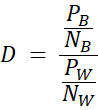
Substituting the jail population formula gives:
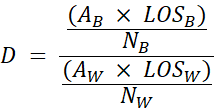
Now, suppose each group’s jail population changes by a reduction factor (r):
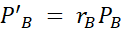
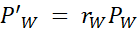
where each reduction factor is between 0 and 1, with smaller values indicating greater reduction. The new disparity is:
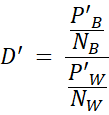
Substitute the group-specific reductions:
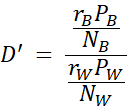
This simplifies to the key result:
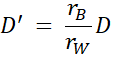
Thus, racial disparity declines only if the jail population decreases more for the overrepresented group than for the comparison group:

If both groups decline proportionately, disparity remains unchanged:

If the overrepresented group declines less than the comparison group, disparity increases even while the total jail population falls:

Summary
Jail population reduction and jail disparity reduction are related but distinct outcomes. The jail population is a stock produced by admissions and length of stay. Racial disparity, however, reflects the relative jail incarceration rates of groups compared with their population denominators. If Pg = Ag X LOSg, then the disparity between groups B and W can be expressed as:
A policy that reduces the jail population will reduce disparities only if it reduces admissions, length of stay, or both more for the overrepresented group than for the comparison group.
If reductions are proportional across groups, disparities remain unchanged,
If reductions are larger for White inmates, disparities can increase even as the total jail population declines.
Thus, reducing the jail population does not mechanically reduce differential treatment. Rather, it depends on the distribution of reductions across groups and across the mechanisms that generate jail populations: admissions, exits, and time served.
