It is striking how enamored the Abundance crowd is of strict policing. This is a surprise to me. I have written about it here and here and the satire and sarcasm therein are prompted by disappointment, not contempt. I certainly understand the pull of order maintenance as a prescription for safer cities. But, it is so outside the original formulation of what it means to be a healthy city that it is worth spilling a few words on the evolution of New New-and-Improved! Urbanism.
Abundance is the latest heir to Jane Jacobs, and carries on the grand tradition of a vision of cities as the soul of America. America, in the Jacobsian telling, can be found in the sidewalk ballet. Introducing order maintenance into the dance is jarring.
Instead of art and music, crafts and trades, lyrics and rhythm, I read more YIMBYs who seem most to crave order.1 How did we get here?
I am keenly aware of the dangers of Substack pontificators wandering blithly into other people’s field of inquiry and thrashing about. But since the authors of Abundance were happy to sell me a copy of their work, I feel free to comment thereupon and thusly.
As an informal heir to the Gladwell guild, I feel duty-bound to keep to the script: story, study, lesson. So here’s a story that’s probably more digression than insight, but it makes me laugh when I think of it. Then I’ll summarize a study that conveniently supports my point of view. Then the lesson, should I turn out to be correct.
The Story
Once upon a time, long, long ago, in a land now two hours and twenty minutes away, I lived in a city for a long while, in a part that had seen its ups and downs. At that time, that part of the city was neither up nor down, just drifting toward an uncertain future.
One night, I was on baby duty while my wife and her sister slept. My still-pretty-newborn but no longer Yoda-looking son was fully awake well before sunrise on a glorious fall morning. So I swaddled him, threw him over my shoulder, and went for a short stroll.
In a couple of blocks, we encountered some light police activity, a couple of patrol cars appearing to investigate a call for a suspicious person or sound. We turned for home as they were wrapping up, but they approached. And had questions. For one, why was I walking with a baby in the middle of the night? And, was it really my baby, as if I would pilfer a sleeping child and then walk softly and slowly about, cooing at him? Perhaps they wondered whether my pint-sized partner in crime and I were the source of the disturbance they were investigating.
I pointed out, gently, that I was no farther from my home than if I were at the edge of a decent-sized suburban yard. They pointed out that I was not in a suburban yard. So, my son and I walked slowly home, with a police escort rolling alongside. Today, I would not refute the argument that mistakes were made. Still, that was our midnight ballet in the city.
The Study
The idea of Jane Jacobs’ ballet is one of the organic creation of order from disorder, where order is improvised rather than imposed. It is not hierarchical in an Aristotelian sense, as class or social status. Or mandated and regulated in the division of the people from the bicycles from the delivery trucks from the buses from the cars. These are all important to separate, of course, and my distaste for internal combustion engines in the public square is as strong as the YIMBYs, I suppose. But the order comes from short blocks, density, connectedness, and other elements of an urban village.
But imposed order lacks authenticity. It creates structures and hierarchies. It chides and scolds. This is all fine, we inhabit a democracy, and so if what we collectively seek is structure and hierarchy and to be chided and scolded, that’s all well and good, and so be it. It’s just not my preference.
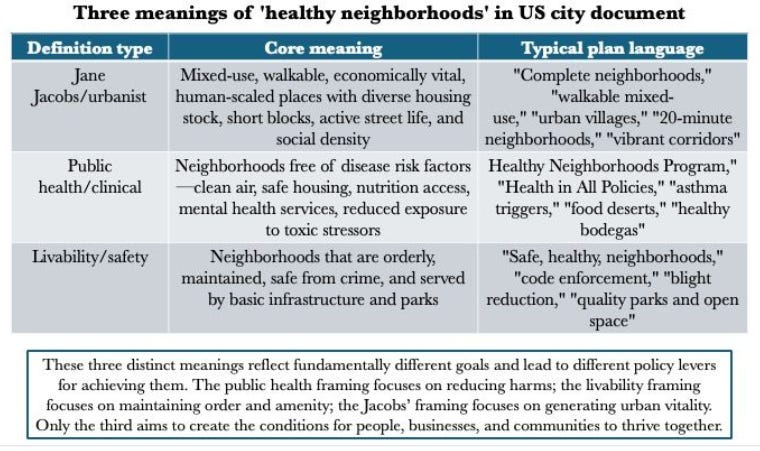
My question is, how did we get here from there? I recently came across an interesting study from the Georgia Tech Center for Urban Research that rates 100 cities on the extent to which they include “healthy neighborhoods” among their planning goals and objectives. They find that only three cities explicitly include “Jacobs conditions of mixed use, walkability, and social density.” (The cities are Portland, Houston, and Atlanta).
But what really caught my eye was this table.
Now, the authors do not explicit talk about this as an evolutionary framework, but it seems relatively safe to posit that there has been a shift over time from Jacobs—> Public Health —> Safety.
They dig into the implications of the first shift, from walkability to public health.
The single most important finding of this research is that “healthy neighborhoods,” as a term of art in American municipal government, belongs almost entirely to public health departments.
…
This is not a superficial observation. It means that the institutional infrastructure of American cities— departments, budgets, personnel, measurement frameworks—that carries the “healthy neighborhoods” brand is oriented toward the prevention of illness and environmental harm, not toward the creation of economically vibrant, pedestrian-oriented urban places. It further suggests that neighborhoods are not universally being treated as unified entities that deliver urban outcomes as complex systems. A city wishing to pursue Jacobs aligned neighborhood goals under this banner would be swimming against a powerful institutional current.
But it is the next shift that has been largely papered over, the shift from public health to safety. I suppose it is natural that if we are to reduce environmental harm and illness, some regulation, or perhaps a lot of regulation, is needed. And if the goal is that cities are “orderly, maintained and safe from crime,” I suppose a vigorous web of code enforcement and policing is necessary.
What I don’t see in this literature, and again I am absolutely not an expert, is any intentionality in the shift toward order maintenance as a natural evolutionary step from public health. It would be just as natural to adapt a much broader lens.
[F]ocusing on the narrow aspects of chrono-urbanism—the time value associated with the ease of mobility—fails to recognize the public safety, educational, health, and economic mobility benefits that emerge from high-functioning urban environments. This runs the risk of undermining efforts to align the efforts of police departments, school systems, public health departments and economic development agencies around what should be the shared goal of creating and sustaining healthy neighborhoods.
My sense is that order maintenance is simply the path of least resistance. Crime is a threat to cities, and rather than solving that problem through complex systems integration, YIMBYs just want it to go away. So they call the police. Never mind that the police have been saying forever that they cannot solve all of the problems that lead to crime by themselves.
The Lesson
My disappointment with the YIMBYs is that this is epistemologically at odds with the rest of their own liturgy. My reading of Abundance is one focused on removing the petty bureaucracy from modern life, to give free rein to creativity and inspiration. I suppose I read this with Jane Jacobs at the back of my mind, and Richard Florida closer to the front, with the swirling idea that metaphor and creativity, not Ordnung, is the guiding principle. Order from disorder. Eyes on the street. Informal social controls, with the emphasis on social, not control.
I am no scholar of urban studies, so perhaps I have misunderstood. When I read Jane Jacobs, the police are not the focal point of my mental images. If they are there, they are guiding a stranger down the way or gently engaging to disperse trouble before it gathers. They are not standing guard, they are involved. They are not instruments of the state, they are part of the scene.
They’ll send you home in the middle of the night if you are doing something dumb, but that won’t rough you up about it. The YIMBYs seem to crave more roughing up, and in doing so, they seem to have lost the thread.
Under the seeming disorder of the old city, wherever the old city is working successfully, is a marvelous order for maintaining the safety of the streets and the freedom of the city. It is a complex order. Its essence is intricacy of sidewalk use, bringing with it a constant succession of eyes. This order is all composed of movement and change, and although it is life, not art, we may fancifully call it the art form of the city and liken it to the dance – not to a simple-minded precision dance with everyone kicking up at the same time, twirling in unison and bowing off en masse, but to an intricate ballet in which the individual dancers and ensembles all have distinctive parts which miraculously reinforce each other and compose an orderly whole.
The ballet of the good city sidewalk never repeats itself from place to place, and in any one place is always replete with new improvisations. The stretch of Hudson Street where I live is each day the scene of an intricate sidewalk ballet. I make my own first entrance into it a little after eight when I put out the garbage can, surely a prosaic occupation, but I enjoy my part, my little clang, as the droves of junior high school students walk by the center of the stage dropping candy wrappers. (How do they eat so much candy so early in the morning?) While I sweep up the wrappers I watch the other rituals of morning: Mr. Halpert unlocking the laundry’s handcart from its mooring to a cellar door, Joe Cornacchia’s son-in-law stacking out the empty crates from the delicatessen, the barber bringing out his sidewalk folding chair, Mr. Goldstein arranging the coils of wire which proclaim the hardware store is open, the wife of the tenement’s superintendent depositing her chunky three-year-old with a toy mandolin on the stoop, the vantage point from which he is learning the English his mother cannot speak. Now the primary children, heading for St. Luke’s, dribble through to the south; the children for St. Veronica’s cross, heading to the west, and the children for P.S. 41, heading toward the east.…
The heart-of-the-day ballet I seldom see, because part of the nature of it is that working people who live there, like me, are mostly gone, filling the roles of strangers on other sidewalks. But from days off, I know enough of it to know that it becomes more and more intricate.
Longshoremen who are not working that day gather at the White Horse or the Ideal or the International for beer and conversation. The executives and business lunchers from the industries just to the west throng the Dorgene restaurant and the Lion’s Head coffee house; meat-market workers and communications scientists fill the bakery lunchroom. Character dancers come on, a strange old man with strings of old shoes over his shoulders, motor-scooter riders with big beards and girl friends who bounce on the back of the scooters and wear their hair long in front of their faces as well as behind, drunks who follow the advice of the Hat Council and are always turned out in hats, but not hats the Council would approve. Mr. Lacey, the locksmith, shuts up his shop for a while and goes to exchange the time of day with Mr. Slube at the cigar store.…
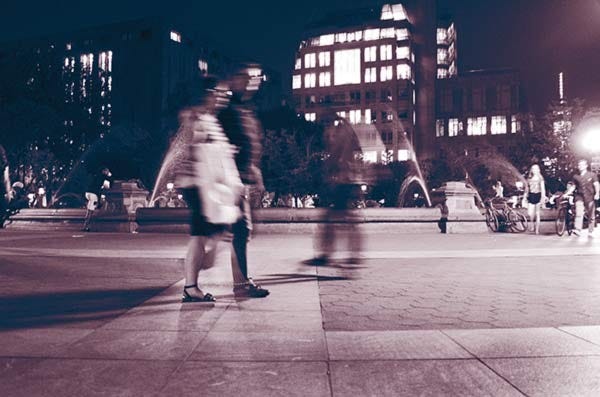
Phil Roeder, Nighttime in Greenwich Village Photograph public domain
The baby carriages come out, and clusters of everyone from toddlers with dolls to teenagers with homework gather at the stoops. When I get home after work, the ballet is reaching its crescendo. This is the time of roller skates and stilts and tricycles, and games in the lee of the stoop with bottletops and plastic cowboys; this is the time of bundles and packages, zigzagging from the drug store to the fruit stand and back over to the butcher’s; this is the time when teenagers, all dressed up, are pausing to ask if their slips show or their collars look right; this is the time when beautiful girls get out of MG’s; this is the time when the fire engines go through; this is the time when anybody you know around Hudson Street will go by.
As darkness thickens and Mr. Halpert moors the laundry cart to the cellar door again, the ballet goes on under lights, eddying back and forth but intensifying at the bright spotlight pools of Joe’s sidewalk pizza dispensary, the bars, the delicatessen, the restaurant, and the drug store. The night workers stop now at the delicatessen, to pick up salami and a container of milk. Things have settled down for the evening but the street and its ballet have not come to a stop. I know the deep night ballet and its seasons best from waking long after midnight to tend a baby and, sitting in the dark, seeing the shadows and hearing the sounds of the sidewalk. …
People who know well such animated city streets will know how it is. I am afraid people who do not will always have it a little wrong in their heads – like the old prints of rhinoceroses made from travelers’ descriptions of rhinoceroses. On Hudson Street … we are the lucky possessors of a city order that makes it relatively simple to keep the peace because there are plenty of eyes on the street. But there is nothing simple about that order itself, or the bewildering number of components that go into it. Most of those components are specialized in one way or another. They unite in their joint effect upon the sidewalk, which is not specialized in the least. That is its strength.
Writer, activist, and pioneer of New Urbanism, Jane Jacobs (1916–2006) fought to save Manhattan’s “old city” neighborhoods from being obliterated in urban renewal projects. This reading is from her 1961 classic The Death and Life of Great American Cities.
For those who would tut-tut this take and point out that those days are long past, I would note that the homicide rate today is lower than it was when Jane Jacobs wrote these words. In a country twice as large as it was then, fewer homes were burgled in 2025 than in 1961, and per capita, there was less petty theft. Rates of car theft are rapidly headed toward 1961 levels. And while there is more assault today, part of that is just a change in who is taken seriously when they report a victimization, and so it is likely not much worse today.
America is, on average, older and wealthier today than it was in 1961, and with that comes less tolerance for risk. But that is a choice. As Dylan Thomas wrote in that same era, do not go gently into that good night.