
2025 Year-End Wrap-up
A Year in Graphics

It is hard to put the 2025 crime decline study into perspective. But let me give it a shot. The best available data from the Real Time Crime Index shows a 19% decline in homicides and a similar decrease in robberies. These are the largest one-year declines recorded by the FBI since modern data collection began in 1960.
If interest rates fell by 19%, 30-year rates would be below 5%, a level not observed in any year between 1971 and 2009.
If the national public debt were reduced by 19%, the one-time savings to the American public would be $7 trillion.
If the median home price in the US fell by 19%, homebuyers would save nearly $80,000.
If fatal car accidents declined 19%, almost 8,000 lives would be saved.
Anyway, you get the idea. There would be all sorts of knock-on consequences from these changes, but surely you would hear about little else but the top line win. The decline in crime is certainly not leading the headlines.
Here’s the thing, though. It will almost certainly be a big story in the future. Tversky and Kahneman’s Prospect Theory teaches that people perceive the psychological impact of losing something as greater than that of gaining the same amount. One need only look at the consequences of recent inflation, which is modest by long-term historical standards, but large compared to the pre-COVID world. Once you have experienced a world with less than 2% inflation, 3+% inflation feels like a significant loss. The same is true for unemployment. For years, economists believed that if unemployment fell below 5%, inflation would follow, and monetary policy reflected this red line. But unemployment collapsed in the 2010s to well below 4%. Today, a return to 4.6% unemployment feels psychologically worse than rates above 5% did for decades.
If crime rises in 2026, even by a smaller amount than it just fell, it is likely to have a significant psychological impact. Will it? Stay tuned.
Let’s look at what we learned in 2025.
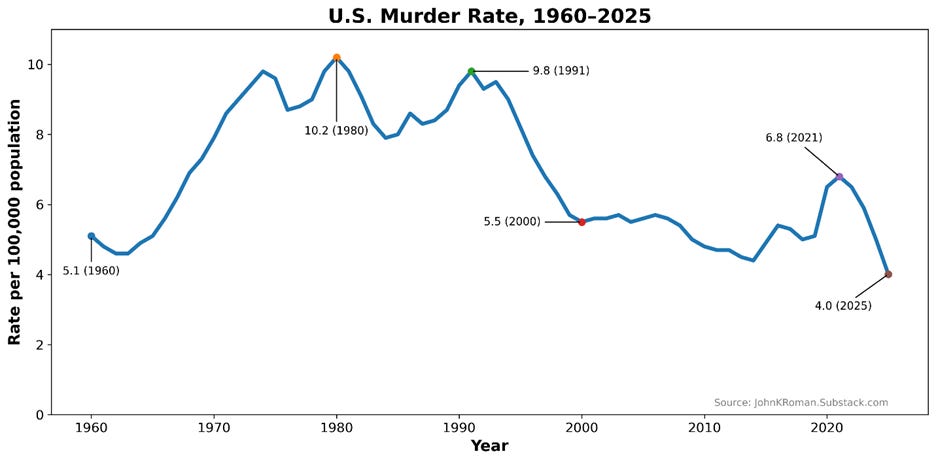
The graphic speaks for itself—homicide rates are now lower than at any point in the last 65 years. For the data, I use the FBI Uniform Crime Reports for 1960-2024, acknowledging that 2021 and 2022 are a mess. For 2025, I apply the year-to-date crime declines observed in the Real-Time Crime Index to the official 2024 FBI data.
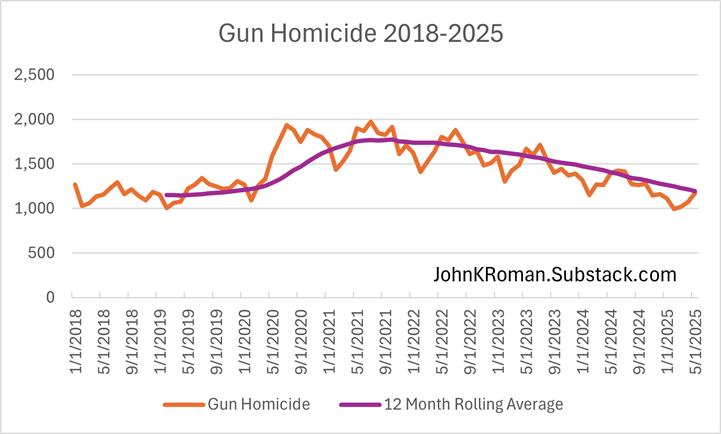
It is worth asking whether this trend is observable only in FBI data or can be validated by sources other than local law enforcement. Public health data from the CDC shows the same trend through May of 2025 (data from the second half of 2025 are not yet available).
It has been suggested that this crime decline is really just a reduction in shootings. I don’t think this criticism is intended to diminish the importance of the decline, but rather to just contextualize it. From my perspective, this argument was effectively put to rest when the FBI reported declines in all top-line crime categories for 2024, including property and violent crime. But let’s take a quick look at aggravated assaults and robberies to confirm that there was a broad crime decline in 2025.
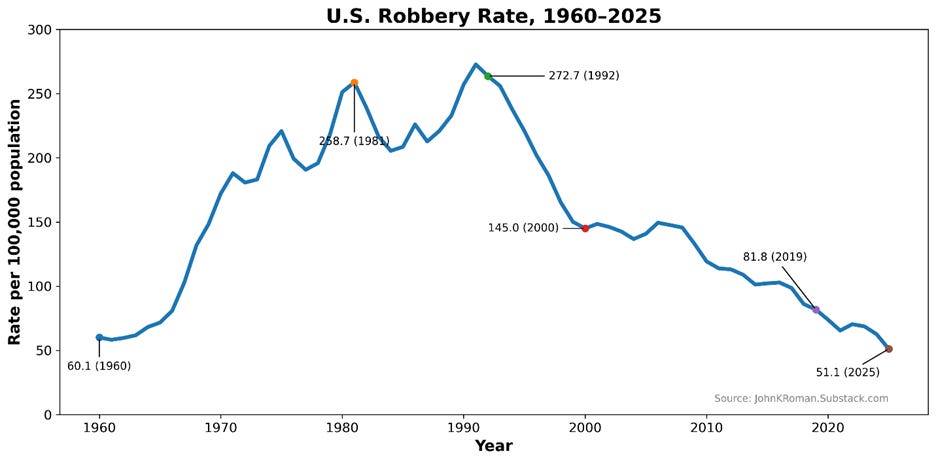
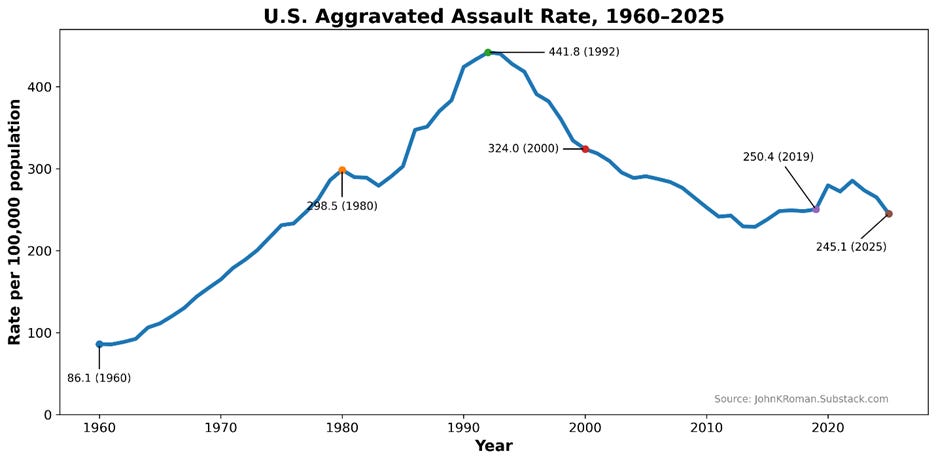
Both trend lines show a marked decline in the last three years. For robbery, that means a continuation of the downward trend since 2009. With respect to aggravated assault, there is also a notable decline beginning in 2022. It is worth mentioning that the US has been less successful in reducing assaults than other types of violence. I haven’t seen a good paper looking into this, and would be interested if others have. I have seen a compelling argument that unauthorized speakeasies popped during the pandemic, and these were both slow to close and likely more prone to violence than their unregulated cousins, lawful on-premise alcohol outlets. There was also a spike in alcohol consumption during the pandemic and there was an increase in domestic violence as a result. But aggravated assault is the only crime category that remains well above 1960s and 1970s levels, and I’d be interested in compelling explanations. Still, it is quite clear that the COVID spike has passed.
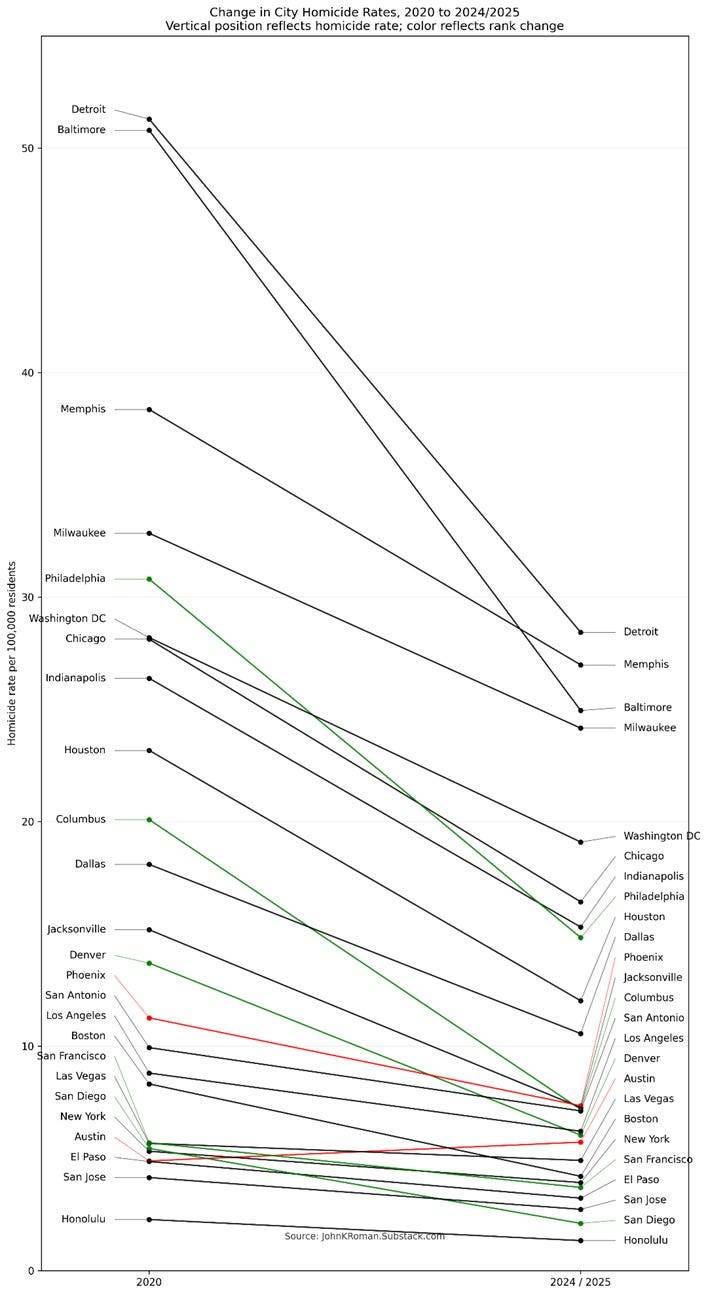
The natural next question is whether these declines are concentrated in a few places or widespread. The evidence suggests that almost every city experienced a decline in crime. For instance, comparing 2020 to 2025, only Austin, Texas, had an increase in homicides.
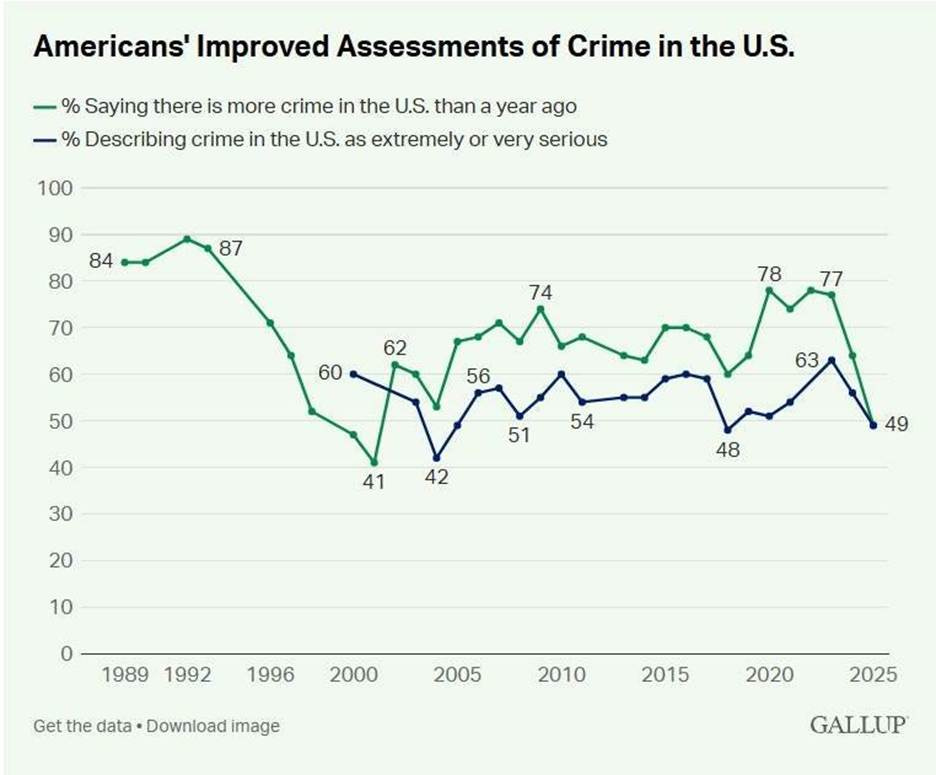
Following on from this, has the public noticed this change? Media is hyper-segregated by partisan affiliation, news is often consumed in a micro-targeted fashion, and as noted in the lede, the media is not exactly busting down the door to tell the story of the crime decline. However, this crime decline appears to have permeated the national consciousness. It is clear that there is a partisan divide—Democrats seemed inclined to note the 2024 decline, while Republican perceptions changed in 2025. Still, it is important to note that Democratic sentiment about the crime decline did not reverse in 2025 in some kind of partisan backlash. While it is still pretty mind-blowing that half of Americans think that there is more crime than there was a year ago, even with all the evidence, these perceptions are more in line with the data than is usually the case (you need only line up this graphic with the historical trends reported above to see the chronic misalignment of perceptions).
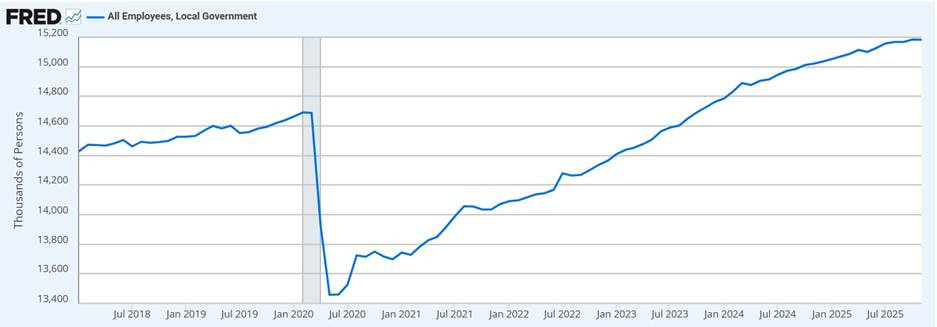
Let me close with a refrain that External Processing regulars will find quite familiar. I believe that the best explanation for the crime decline is that it is a distinctly national phenomenon rather than a local one, and that the key mechanism is the growth of local government. Local government is a catch-all term, as it encompasses local police, schools, and local grant-making to local non-profits. But what unites all of the people and their duties is contact with young people who are at the greatest risk of violence and victimization. This means more people spending more time removing obstacles and creating opportunities for young people.
Finally, I just want to say a word about the two alternative explanations for this crime decline that I often hear. One is that this is just a reversal of fortune, a regression to the mean. This is just the end of a COVID-19-driven crime spike. In 2023, the overall crime trends resembled the aggravated assault graphic above, showing a spike followed by a return to approximately pre-pandemic levels. With two years of additional data, the trends clearly show a much different pattern today. The pattern of the decline is the opposite of what you would expect if this were merely a return to normal. A return to normal pattern would most likely show big initial declines that gradually slowed and flattened out. The air from a balloon does not rush out slowly at first, gain steam, and peak in volume at the moment the last of the helium is expelled. But that is exactly what is happening. Today, we observe a decline that, more than five years after COVID-19 ended, continues to accelerate. This highlights the main problem with the return-to-normal explanation: there is no evidence supporting it.
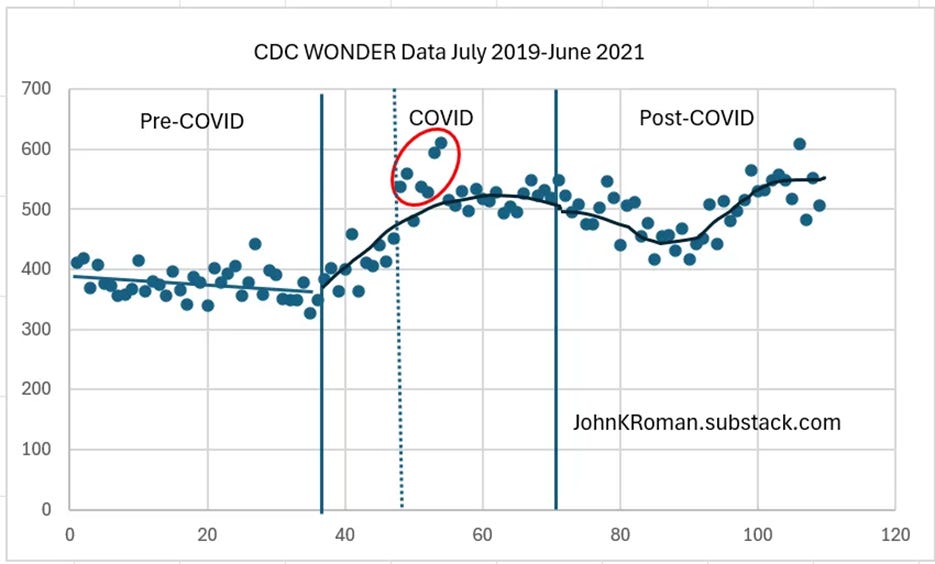
This brings us, then, to the ‘protester’ explanation. This theory received substantial support in 2022 and 2023. The idea was that the protests around George Floyd’s murder caused crime to spike and that after the protests ended, violence returned to normal. This narrative no longer fits the evidence for the same reasons that the return-to-normal explanation does not fit. In retrospect, it appears that the protests contributed to a few weeks of higher violence than would otherwise have occurred (the red circle highlights the weeks when protests were most widespread). But that’s all.
In summary, this is most likely a crime decline driven by prevention rather than deterrence.
A Different Year-End Round-up
Max Read is a national treasure, and I will fight you on this. With a nod toward the inanity of end of the year lists (including my own!), Max gives us his top ten top ten lists (and no Grammarly, I don’t need to fix that). Highlights include:
Musical Interlude
My best New Year’s resolution ever was the year I resolved that when confronted with something on a menu or elsewhere that I had never heard of, I would eat it. That was a (mostly) good year. This year, I have a simpler resolution. There seems to be more ugliness about than I can ever recall, and it finds you. If you want beauty, you have to go and find it. So let’s do that. Caterina found this, and now it’s yours.
I believe the homicide decline is global and not just limited to the US. If so, that suggests other factors at play other than just US prevention efforts.
I think you misstate the COVID spike case. It's not that after the spike we go back to some static normal. It's that the New Normal as Gen Z comes into prime crime committing age is that crime has been declining significantly for quite some time, as you document, and after the COVID, generated spike, that prior trend continued. There were fewer shooters in this generation to begin with and, after a bunch of them shot each other over a 2 year period, the prior downward trend accelerated once we were past the COVID lockdowns and their aftermath. IMO that's a much more supportable thesis than nebulously attributing it to local government spending. Just a few years ago you were attributing crime levels to police-force size, but clearly that thesis has been blown apart by the experience last 5 years. Police force sizes are down and crime is plummeting. So if local government employs fewer police, you'd have to say what spending you believe is causing the crime decline, bc it's not roads and bridges, and spending on homeless diversion has been controversial.