
Comparative advantage versus competitive advantage and AI vs Human Beings
And why AI job loss in the professional classes isn’t inevitable

The point of this essay is to say that despite AI’s competitive advantages over humans in possibly all the things, humans have comparative advantages over AI that are likely sustainable in the very long term. At the end of this essay, I will give you three obvious areas where this comparative advantage exists, but there are many more. Don’t throw in the towel, human!
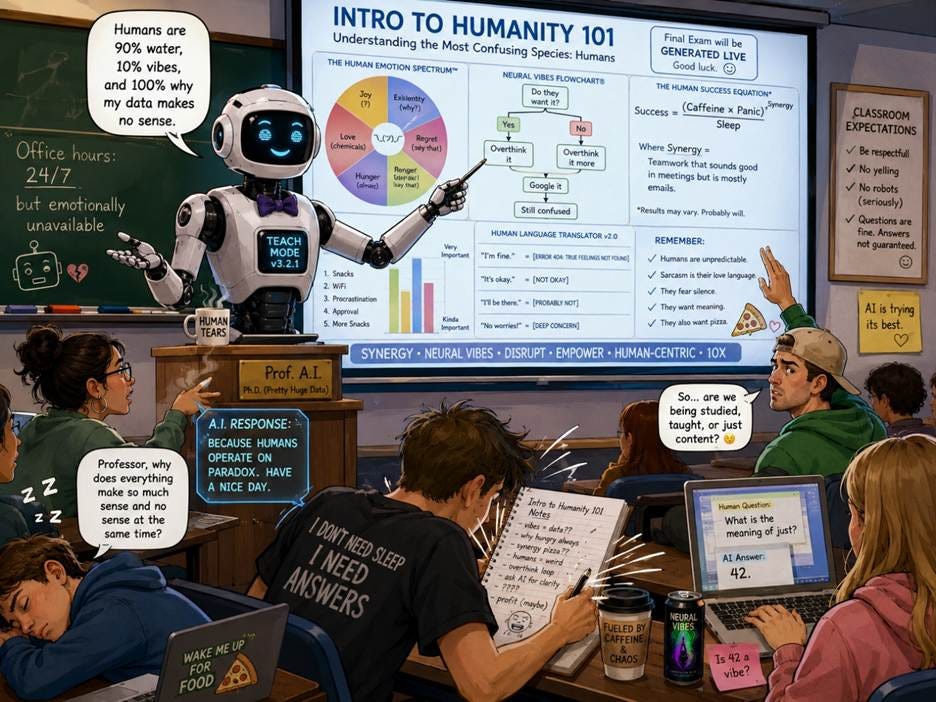
I asked AI to make a funny picture of an AI teaching college students, and this was the best of the bunch. It is definitely not funny. And while AI could focus trillions of dollars worth of compute into being funny and dominate humans there, it won’t because there are much more lucrative pursuits, as many a sad clown can affirm. That’s a metaphor, by the way.
Here’s an AI-Level joke, which is also a metaphor.
Two guys are hiking through the woods. Suddenly, they realize they have come between a momma bear and her cub. One guy takes off running, the other stops to tie his shoe. The running guy yells back to the tying shoe guy, “what are you doing? You can’t outrun a bear!” and tying shoe guy says, “I don’t have to outrun the bear, I just have to outrun you.”
***
I think a lot of professors and PhD students read this blog (thank you!). As further thanks, let me say some nice things about you. Being a professor or an advanced graduate student requires a substantial and diverse skill set.
You must be exceptionally well read. I’ve seen the quote that 90% of what professors do is talk about someone else’s work. That’s an exaggeration, but you are required to have a whole library of notable studies at your fingertips and to say thoughtfully how they do or do not integrate into a coherent whole. (This is also obviously true for attorneys, doctors, and many other professionals, but right now I am sending sunshine your way, academics.)
You must be an excellent public speaker. You will teach, whether you love it or not, and while it is not your primary performance measure, it matters. In addition to teaching, you are expected to regularly travel to other universities and various academic conferences to discuss your work. If you want to dance up the academic hierarchy, being an excellent public speaker is key.
You must be a good marketer. Unless you manage to hit a home run and come up with a legitimately new and earth-changing idea, your scholarship will fall into three buckets: the slow grind of academic scholarship where you extend (or narrow) established theory; the slow grind of academic scholarship where you extend (or narrow) a research method; the bundling (or unbundling) of established thought on some topic. Explaining why your scholarship advances the field is critical.
You must be an outstanding writer. Now, academics get a lot of grief for writing, well, academically. But that criticism misses the mark. An equation, for example, is often worth a thousand words. A page or two of statistical notation can communicate more information than a paper’s worth of prose. Communicating this accurately gets a paper through peer review and gets it cited. This is the key performance metric for many research institutions.
You must be a good colleague and an outstanding mentor. Woe be the lone wolf in academia. Having colleagues and mentees you can write with is the surest path to success on another key performance metric, volume. People will write with you if they respect you, and they will write with you if they like you. If people like and respect you, that’s best.
There are many other important skills you have to have in academia to perform at a high level. And again, professionals in many other fields will look at this last and say, to one degree or another, this is all true for me as well. And it is.
This is why AI will not take your job. Because while you may not have a competitive advantage over AI in any of these domains, you certainly have the capacity to have a comparative advantage. This comparative advantage could turn out to be in one or two of these areas. Or, it could be a competitive advantage to do all of these together better than AI can do them together. It is not obvious yet what specific direction this will all take. But it seems equally obvious that putting the human at the core of learning will be perpetually competitive.
The logic is simple. AI growth is measured one benchmark or task at a time, which is used as evidence that AI is superhuman, rather than simply demonstrating that AI is better than humans at this one benchmark. This is extrapolated to the generalization that AI will necessarily crowd humans out of this task. Ha ha. But human jobs are always a portfolio of things, and while AI is increasingly capable of linking tasks together, integrating tasks is not the same as doing a complex job. So, ha ha right back at ya, smug Silicon Valley guy.
Here’s what I mean by the difference between competitive advantage and comparative advantage. Noah Smith wrote a great piece articulating this difference.
When most people hear the term “comparative advantage” for the first time, they immediately think of the wrong thing. They think the term means something along the lines of “who can do a thing better”. After all, if an AI is better than you at storytelling, or reading an MRI, it’s better compared to you, right? Except that’s not actually what comparative advantage means. The term for “who can do a thing better” is “competitive advantage”, or “absolute advantage”.
Comparative advantage actually means “who can do a thing better relative to the other things they can do”. So for example, suppose I’m worse than everyone at everything, but I’m a little less bad at drawing portraits than I am at anything else. I don’t have any competitive advantages at all, but drawing portraits is my comparative advantage.
Imagine a venture capitalist (let’s call him “Marc”) who is an almost inhumanly fast typist. He’ll still hire a secretary to draft letters for him, though, because even if that secretary is a slower typist than him, Marc can generate more value using his time to do something other than drafting letters. So he ends up paying someone else to do something that he’s actually better at.
And, really, it is that phrase “can generate more value” that is salvation. Because AI resources are not infinite, it may be true that AI is better at each possible thing than a human, and still not push humans out of the market. AI may be infinitely smart, but there are not infinite resources available to AI. Even when AI is better than a human at every individual task, it may still be efficient to allocate AI capacity to the tasks where its advantage is greatest, leaving humans to perform tasks where the productivity gap is smaller. There is an opportunity cost to AI, just as there is with any constrained resource.
We are already seeing this, as the heady days of wanton capital investment in chips and compute is slowing. To be the best at all the things, AI would need all the investment. That’s not happening and won’t happen. There are other ways to make money, and most people have a comparative advantage in making money some other way, like drawing portraits. So they will continue to invest in charcoal pencils instead of AI.
So, what is likely to happen in the AI space? AI profiteers are likely to identify a few streams of revenue where the AI comparative advantage is extremely lucrative. And they will compete like demons for these dollars. We simply don’t know yet what tasks will turn out to be most lucrative, and thus where AI will focus. We do know, beyond a shadow of a doubt, that once there is gold in them hills, AI speculators will rush in with a decidedly winner-take-all mentality. AI will compete really hard for a few things, but not for all the things.
That leaves a lot of space for humans to exercise their comparative advantage. It still will be true that if AI decided to come into any new space, it will have a comparative advantage there as well. But I reiterate, AI cannot compete everywhere; the laws of specialization in a resource-constrained world apply to AI just as they do for any other product. AI has to choose.
Now, all of that is a bit of a rehash of things that have been written before, so let me offer three hopefully newish insights.
First, let me talk about new insights. One area where I think humans have both a comparative and a competitive advantage is in idea generation, and I don’t see this advantage being ceded to AI anytime soon. The French philosopher Henri Poincaré points out that a hypothesis can never be proven, it can only be disproven. This is because for an idea to be proven true, it must be the case that every possible counterargument is tested and disproven. Since there are an infinity of possible competing hypotheses, this can never happen. Humans are amazingly good at coming up with new, untested, competing hypotheses, but where they differ from AI is in generating meaningful ones. If you ask AI for 100 testable alternative hypotheses, you will get a list. But if you want to generate one meaningful idea from experience, anomalies, analogy, values, and judgment, you probably have to do that yourself. AI does not have a comparative advantage when it comes to original thinking, intuition, and imagination.
Now, you may say, when the singularity comes, AI will become better at ideation than humans. And I say, fair play. But I’m not holding my breath. Because there is very little money in ideation. Trust me, I live in this space. Try publishing an op-ed on your new idea—you will find no takers. Nor is there much interest in new ideas in business. We are up to season 237 of Shark Tank, and I think the two biggest ideas from 1,000 pitches are Sponge Daddy and Squatty Potty. Can you imagine focusing trillions of dollars of AI compute on creating the next Squatty Potty? I can’t. Those dollars are bound for somewhere else.
The second area where humans are better than AI and will remain so for a long time is in the realm of solving endogenous problems. The simplest example of endogeneity is the chicken and the egg. Egg cause chicken. And, chicken cause egg. Which came first? Now, your AI can probably handle that one, but most of the human experience is trying to solve much harder endogeneity problems. I think I am falling in love with her, but I will only allow myself to fall if she loves me back. She will only love me back if I commit to her, but I can’t commit to her unless I know that she loves me back. And around we go. Simultaneity, reverse causality, unobserved heterogeneity, all of the sources of endogeneity, these are the things we think about, talk about, and try to solve as humans. And our advantage over AI? We are not merely modeling these endogenous decisions in the abstract, we are embedded in them. I would argue this is one area where humans have a huge competitive advantage over AI.
And finally, and most importantly, portfolios. Policy is about making choices, about making tradeoffs. It’s also about doing many things in combination, and here humans have a comparative advantage. Humans, by nature, are doing many things at once, whereas AI, by nature, is doing one thing at a time. Now it can do a huge number of one-thing-at-a-time sequences faster than maybe a human can do a single thing. But that is very different from doing many things at once or at least combining many things into one. AI can execute many operations rapidly and combine their outputs, but good judgment requires deciding which goals matter, which tradeoffs are acceptable, and who is accountable when values conflict.
I don’t really see these problems as surmountable for AI in the foreseeable future. That leaves me bullish on humans.
Guns purchasing is national
Readers of this blog are familiar with my argument that crime tends to move in narrow channels until some large national force pushes it out of equilibrium. This idea is unpopular in my field. The responses I see in print to this idea tend to manifest in a broad dismissal via a vague hand wave and light chuckle. I think there are two primary reasons for this. One is just that most folks in my field study people, communities, or systems, and for someone to come along and say that an important component of crime is none of these things is off-putting. Second, empirically, this research takes me out of the comfortable zone of effects of causes, of traditional inference, and into causes of effects, which can appear to be faith, or magic, or voodoo. Or at least really hard to prove. I understand all of that.
So, I was happy to see a paper last in the Journal of Quantitative Criminology, a flagship journal of the field, that argues that gun buying is driven by national forces, not local ones. In “Is Gun Demand National? Evidence from Google Searches and NICS Background Checks”, Johnson, Elliot, Dooley, and Stickle test the association between interest in guns, as measured by Google searches, and gun buying, as measured through background checks, while controlling for local gun homicides.
This allows them to test whether within-state variation explained more gun buying than between-state gun buying. That is, is what is happening in your own state a better predictor of your interest in buying a gun, or are there national forces driving your interest. They find
national events and sentiment appear to account for a large share of the within-state variation in gun interest and transaction
Gun homicides within the buyer’s state have almost no effect at all.
Musical Interlude
I was very sorry to hear that Glen Hansard died in a motorcycle accident yesterday morning. If only the good die young, I suppose he was lucky to make it this far. A brilliant musician and a lovely person, he will be missed. This is Glen entertaining the people waiting in line for his show.
A Brief Programming Note!
I typically make most of my posts public, but for the next few essays, they will mainly be behind a paywall. This blog was named External Processing to reflect my original goal here, to think out loud, to see which kernels of an idea had merit, and which should be set aside. Now, though, with a bit of an audience, those half thought through essays seemed a bit undercooked. But I am working on a long-term idea, and I’d like to road test some ideas here, without exposing them to too much road. So, it would be great if you subscribed and kibetzed a little.
